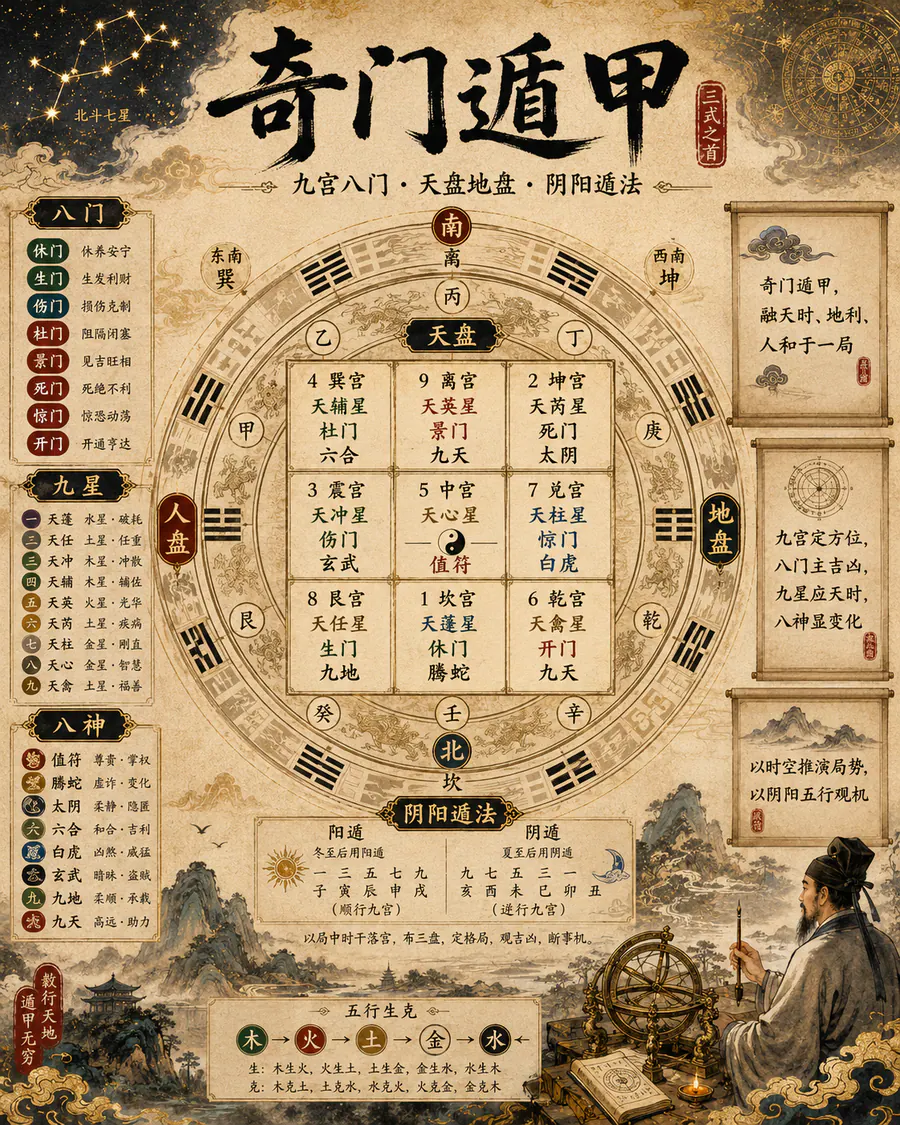


This is the foundation of the Qimen strategy art. Study the imagery and movement of the Open, Rest, Life, Harm, Delusion, View, Death, and Fear Gates and learn to recognise the timing of advance and retreat, forming a foundation for later design, planning, and breaking of situations.
Chapter OutcomeUse the Eight Gates to read movement, opportunity, pressure, and the next practical opening.
Section 1 Building the Eight Gates
Study the imagery and energy of the eight gates — Open, Rest, Life, Harm, Delusion, View, Death, and Fear — and learn to recognise how a situation moves forward, pauses, creates pressure, closes, or opens a route.
What You Can DoRecognise the practical qualities carried by each of the eight gates.
Section GoalEstablish the gate system as the foundation of strategic observation.
Completion StandardUse the gate relationship to describe a situation's movement and pressure.
Section 2 Breaking a Situation with Unusual Strategy
Study the distribution and restraints among the palace, star, gate, and spirit. Learn strategic methods such as shifting stars and exchanging measures, and opening a passage by dismantling, supplementing, connecting, and transforming, so that a deadlock in work, wealth, or relationships can reveal a possible route forward.
What You Can DoIdentify a practical next step inside a situation that appears closed.
Section GoalTurn chart relationships into a conditional strategy rather than a promise of control.
Completion StandardState the assumptions, limits, and responsibilities attached to a proposed action.
Section 3 Using One Situation to Shape Another
Move beyond the limits of one isolated event and look at the whole situation from the perspective of Heaven. Use the relationships of apparent and hidden movement, generation and restraint, and transformation in the Qimen chart to construct a higher-level new situation that can contain, transform, or dissolve the current deadlock.
What You Can DoSee how changing the frame of a situation can change the available choices.
Section GoalStudy strategic design at the level of the whole situation instead of one move.
Completion StandardCompare an immediate tactic with a wider strategy and explain their trade-offs.