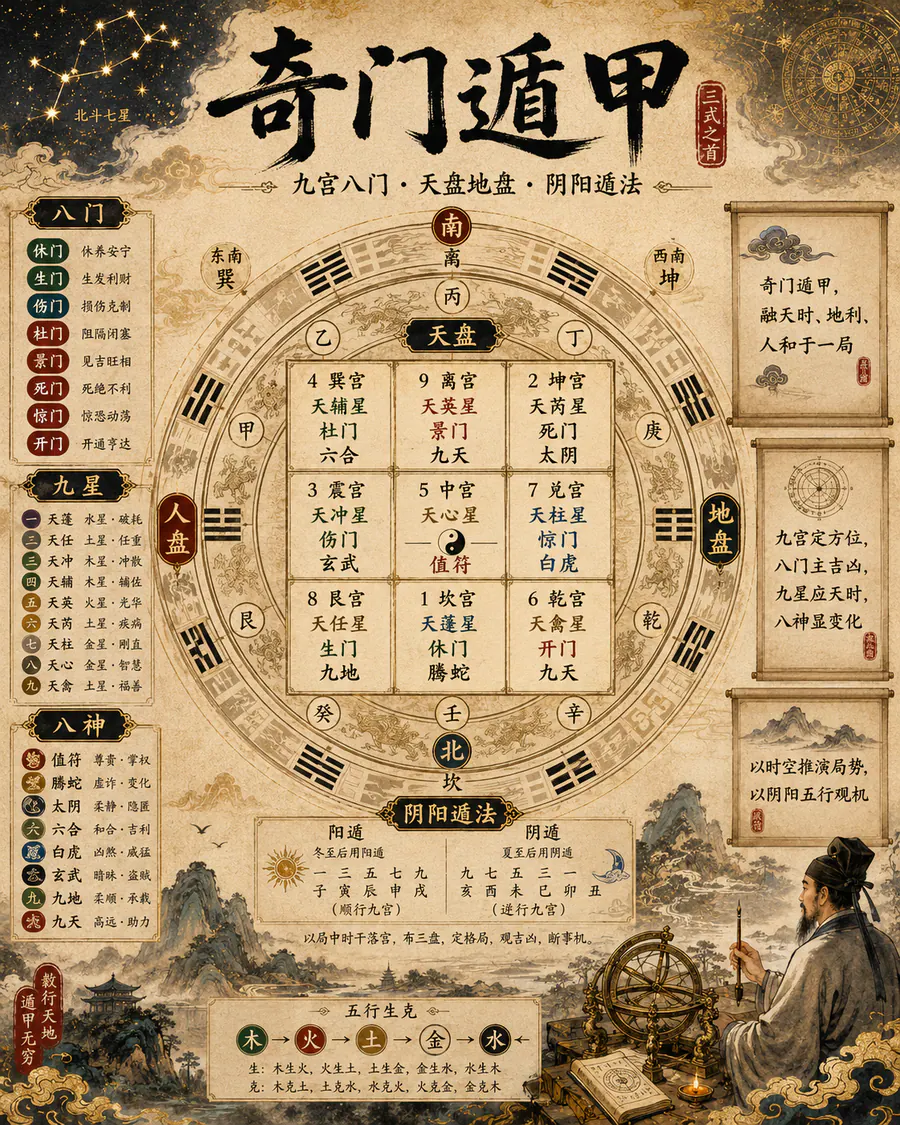
Form recognition and hidden-object inference use the symbols of the Qimen chart — palaces, stars, gates, spirits, the Three Wonders, and the Six Instruments — to infer the elemental quality, shape, material, colour, quantity, and condition of a covered object. In the complete Qimen system, this is a practical module for training the eye to read the chart as a whole.
Chapter OutcomeBuild the first complete movement from chart symbols to a conditional description of a person, event, or object.
Section 1 Reading Forms and Hidden Objects
Study how information in a Qimen chart can be used to infer the Five Element quality, shape, material, colour, quantity, and condition of an object that is hidden from view.
What You Can DoRecognize the symbolic information needed for a first form-reading exercise.
Section GoalTranslate a complete group of chart symbols into a conditional description.
Completion StandardExplain the difference between a symbolic inference and a verified physical fact.
Section 2 Reading Forms and Understanding Meaning
Focus on the core Qimen reading method. Translate the symbolic language of the palace, star, gate, spirit, Three Wonders, and Six Instruments into the concrete state of a person, event, or thing, moving from seeing a symbol to understanding the situation it represents.
What You Can DoRead the main image of a chart and connect it to a concrete question.
Section GoalDevelop a repeatable path from symbol recognition to interpretation.
Completion StandardProduce a clear first reading without relying on a single isolated sign.
Section 3 Distinguishing Forms and Understanding Principles
Systematically unpack the shared-image logic of the Nine Palaces, Eight Trigrams, stars, gates, spirits, and instruments. Understand the operating principles behind the symbols so that chart reading can move from mechanical application to reasoned interpretation.
What You Can DoUnderstand why a symbol can carry different meanings in different chart relationships.
Section GoalConnect the visible image, its structural context, and the principle used to interpret it.
Completion StandardExplain the reasoning behind a reading instead of only repeating a memorized judgement.